Is Screen Use in Young People the Cause or the Symptom?

Correlation or Causation?

We are living through a strange historical paradox. Modern children are safer from physical harm, medical neglect, and structural danger than any generation in human history. Yet, beginning in the early 2010s, rates of adolescent anxiety, depression, and self-harm broke away from historical trends and surged upward into a full-scale crisis.

When searching for the roots of this phenomenon, cultural commentary often forces a false choice: Is it the physical overprotection of children, or is it the digital hyper-connection of the smartphone?

Two of the most prominent contemporary voices on youth well-being—researcher and psychologist Dr. Peter Gray and social psychologist Jonathan Haidt (The Anxious Generation)—are frequently framed as tackling separate culprits. Gray points to the systemic elimination of free play and unsupervised autonomy, while Haidt points to the rapid takeover of childhood by the phone-based life and social media algorithms.

Yet, when we look past the surface-level diagnosis of tools versus playgrounds, a profound convergence emerges. Haidt and Gray are not telling different stories; they are describing two halves of the exact same coin. Together, they reveal that the smartphone did not hijack childhood out of nowhere—it conquered a vacuum left by a society that had already locked its children indoors, moving at the frantic pace of the world rather than the steady, patient pace of nature.

The common denominator: The Evolutionary Mismatch

At their core, both Gray and Haidt operate from the same fundamental, scientific reality: human children are biologically and evolutionarily adapted for a specific developmental niche.

For thousands of years, human childhood was defined by physical reality. It was an apprenticeship in the real world, anchored in open-ended play, natural risk exposure, cross-age peer socialization, and real-world friction. Children grew resilient precisely because they were forced to navigate physical reality, resolve social disputes without adult referees, and learn to master their own fears.

Both authors agree that modern society has engineered an unprecedented, catastrophic departure from this evolutionary blueprint. We have substituted a world of physical breadth, messy experimentation, and deep community roots with a sterile, hyper-managed environment. Whether through the risk-averse panic of modern parenting—which treats every scraped knee or unsupervised walk to the park as a mortal threat—or the frictionless, hyper-stimulating glow of a glass screen, the traditional upbringing of children has been severed from its natural foundations.

Parallel Pillars: Where Haidt and Gray Converge

Far from contradicting one another, Gray’s work on play deprivation and Haidt’s work on the phone-based childhood run on parallel tracks, sharing three foundational pillars:

  • The Death of Agency and the External Locus of Control: Both thinkers recognise that modern children suffer from a profound deficit of autonomy. Gray demonstrates that when adults strip away free play, children lose their internal locus of control, leaving them vulnerable to anxiety because they never practice being the masters of their own fate. Haidt maps this exact same vulnerability onto the digital space: social media algorithms externalize a child's self-worth, tethering their emotional stability to quantifiable, algorithmic validation.

  • Adult Over-Involvement and Hyper-Regulation: Both critics point an accusing finger at a culture that bubble-wraps children in the physical world, substituting helicopter parenting and hyper-scheduled routines for genuine unstructured freedom. When children feel restless or suffocated by this over-managed existence, well-meaning adults hand them a smartphone—a digital pacifier to keep them quiet, contained, and "safe" indoors.

  • The Need for a Collective Cultural Correction: Neither author treats this crisis as a failure of individual parenting that can be fixed with lifestyle hacks. Both argue that the problem is systemic, requiring a coordinated, community-level response to reclaim neighborhood autonomy, restrict screen culture, and restore sanity to how we raise the young.

The Bridge: Why the Phone Won

When we bridge their arguments, the full picture comes into sharp focus.

The smartphone did not conquer a healthy, thriving generation of children. It colonized a generation that was already profoundly isolated, heavily monitored, and starved of real-world agency. By the time mobile internet saturated the market around 2010–2012, children had already been pulled off the streets, out of the woods, and away from the spontaneous neighborhood play groups that once built natural resilience.

When children were told they could no longer explore the physical commons, they retreated indoors. The smartphone became the inevitable substitute for peer socialization. It offered a clever, hyper-addictive simulation of connection to minds that were evolutionarily desperate for community. But unlike real-world play—which teaches emotional regulation through friction and face-to-face empathy—the digital substitute delivered its rewards through a frictionless loop that bypassed every natural human guardrail, feeding an insatiable consumer appetite for "more, more, more".

Reclaiming the Rooted Life

Reconciling Dr. Peter Gray and Jonathan Haidt gives us a complete roadmap for healing the anxious generation. It tells us that a two-front stewardship is required:

  1. We must reclaim the physical commons: We have to loosen our grip as adults, give children back their unsupervised time, and normalize the reality that children grow brave by facing manageable physical and social risks in the natural world.

  2. We must close the digital escape hatches: We must build collective social boundaries that protect childhood from the predatory design of the phone-based consumptive life, recognizing that digital connection is a part of life, but a poor substitute for the messy, grounding reality of face-to-face community and the Earth.

Ultimately, the anxiety crisis is a symptom of a deeper root, not necessarily the cause. When we lock children away from the seasons, the dirt, the risks, and the unmediated freedom of the natural world, we shouldn't be surprised when they seek refuge in the virtual glow of a screen. To heal the generation, we do not simply need to take away their phones—we need to give them back their world.
Beyond Competence: Why the Fundamentals Make the Cake

I may trust you with my life, but do I trust you with my money and my wife?"— Simon Sinek. True character goes beyond just getting the job done on the battlefield or in the office.

Have you ever known or worked with an absolute genius—a surgeon, a master builder, or a brilliant developer—only to find them impossible to work with? Alternatively, have you ever encountered someone incredibly eager and pleasant, but who simply couldn't deliver the basic quality of work they promised?

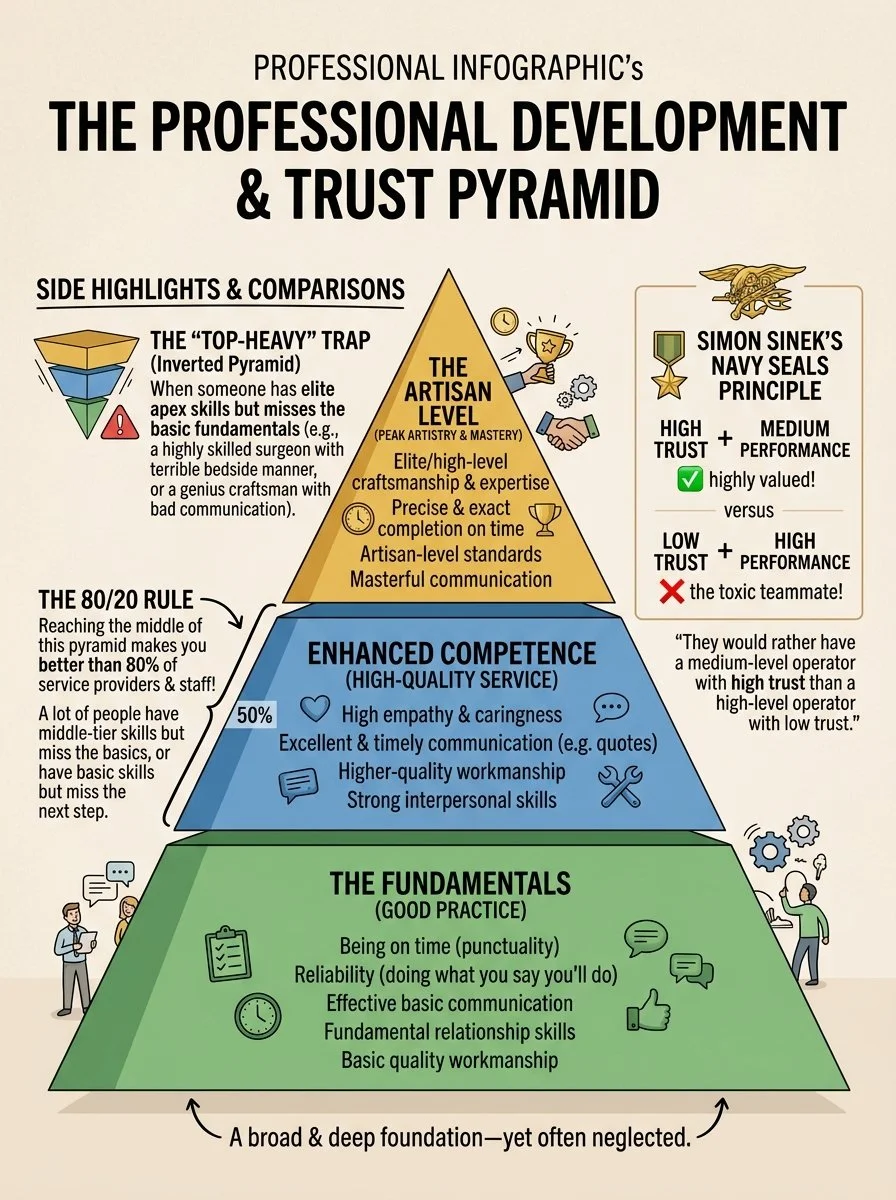
In any profession, whether we are talking about employees, service providers, or just being a decent human being, there is a sliding scale of capability and character. To make sense of what truly makes a "good" member of staff or service provider, we can look at it as a pyramid: The Professional Development Pyramid (see below).

While many focus entirely on reaching the "artisan" peak, the reality is that the true differentiator in the modern world isn't always elite craftsmanship. It’s also the fundamentals at the bottom, and the trust that holds it all together.

The Three Tiers of the Professional Pyramid

The pyramid is divided into three distinct levels, each building on the last. To understand why some people thrive while others struggle, we can look at how these tiers interact:

1. The Base: The Fundamentals of Good Practice

At the very bottom of the pyramid lies the broadest, deepest, and most crucial section: the fundamentals. These are the non-negotiables of being a reliable human being and a functioning member of any team.

  • Punctuality: Being on time.

  • Reliability: Doing what you say you are going to do.

  • Effective Basic Communication: Answering the phone, replying to messages, and keeping people informed.

  • Basic Relationship Skills: Having fundamental empathy, understanding, trustworthiness, honesty, and caring for the person on the other end of your service.

  • Basic Quality Workmanship: Possessing the standard, foundational skills required to do the job (for example, a roofer knowing how to safely and correctly lay a basic tile).

  • Problem Solving: Being proactive and accountable.

This is the bedrock. Without it, the rest of the pyramid has nothing to stand on. Yet, surprisingly, this is the area most frequently neglected.

2. The Middle: Enhanced Competence & Quality Service

As we move up, the skillset and interpersonal qualities become more refined. This is where a good worker becomes a truly valuable one.

  • Higher Quality Workmanship: Going beyond "good enough" to deliver truly great, durable work.

  • High Empathy & Caringness: Genuinely caring about the client’s experience or your teammate’s workload.

  • Excellent, Timely Communication: Being proactive—sending quotes quickly, addressing issues before they become problems, and actively listening.

  • Strong Interpersonal Skills: The ability to navigate difficult conversations, collaborate, and build positive, lasting relationships.

3. The Apex: The Artisan Level (Peak Artistry & Mastery)

At the very top sits the apex—highly specialized, elite-level mastery.

  • Elite Craftsmanship & Expertise: Exceptional, artisan-level standards that only a tiny percentage of people can achieve.

  • Precise, Exact Completion: Flawless execution, perfectly on time, every time.

  • Masterful Communication: Advanced, seamless navigation of complex environments.

The 80/20 Rule: Halfway Up is Better Than Most

We often assume that to be successful, we must claw our way to the very top of the apex. But there is a liberating truth about the 80/20 rule of professional standards: reaching just the middle of this pyramid makes you better than 80% of the people out there.

A vast number of service providers and employees have decent middle-tier skills, but they constantly trip over the bottom. They might be great at their craft, but they don't show up on time, they don't return calls, or they don't do what they said they would do. Conversely, some have the best intentions but lack the competence to get halfway up the triangle.

If you can master the fundamentals—showing up, communicating, and caring—and pair that with good, reliable quality (the middle tier), you will already be vastly more successful, trusted, and sought-after than the vast majority of your competition.

Beware the "Top-Heavy" Trap: The Inverted Pyramid

What happens when we ignore the base? We get the "Top-Heavy" Trap. This is an inverted pyramid—highly unstable and toxic.

This happens when someone possesses elite, apex-level skills but lacks the basic fundamentals. The classic example is the world-class surgeon who performs flawless, life-saving surgeries but has such a terrible bedside manner that patients and staff dread interacting with them. Or the genius contractor who can build a masterpiece but refuses to return your calls, misses deadlines, and leaves you completely in the dark.

In these cases, high skill is ruined by terrible character and communication. Over time, the instability of lacking a foundation causes this top-heavy structure to topple, leaving behind broken trust and frustrated teams.

Simon Sinek’s Navy SEALs Principle: Trust > Performance

This brings us to a vital insight popularized by Simon Sinek, regarding how the US Navy SEALs select their most elite teams.

When the SEALs evaluate candidates, they look at two metrics: Performance (how good you are on the battlefield) and Trust (how good you are off the battlefield, as a person).

  • High Performance + Low Trust = A toxic leader/teammate.

  • Medium Performance + High Trust = A highly valued, natural leader.

Sinek’s takeaway from the SEALs is profound: "They would rather have a medium-level operator with high trust than a high-level operator with low trust."

In the corporate world, we often promote and tolerate the "high performer with low trust"—the toxic high-achiever who makes everyone else’s lives miserable. But just like the Navy SEALs, the best teams, the best businesses, and the most successful service relationships are built on trust.

Conclusion

You don't need to be an elite, apex "artisan" to be highly successful and respected. Focus first on building a broad, unshakable foundation of fundamentals: show up, do what you say you’ll do, and treat people with basic respect and empathy.

Once you have those basics locked down, strive for good quality and excellent communication. By doing so, you will climb halfway up the pyramid—and find yourself head and shoulders above the rest.

Get Back Pain? The best movement is your next one.

The Guardian provided a very useful article on back pain based on the work by Professor Peter O'Sullivan’s research group. If you experience back pain, I have provided a brief summary for you here.

Key Points:

Summary: "The Best Movement is the Next Movement"

The central theme is that back pain is rarely caused by structural damage (like broken bones or torn muscles) but is often a result of nerve sensitisation triggered by muscle spasms, stress, and a lack of varied movement.

1. The Cause: Stress and Sensitisation

The Spasm Loop: About 95% of back pain episodes occur when a person is run down, stressed, or sleep-deprived. A minor movement (like bending for a coffee mug) triggers a protective muscle spasm.

Nerve Sensitivity: This pain often causes people to "seize up" and stop moving to protect the area. Ironically, this lack of movement makes the nerves more sensitive to even minor stimuli, creating a cycle of chronic pain.

Imaging vs. Reality: Scans (MRI/CT) often show no difference between people with pain and those without. The pain is real, but it’s often a functional issue rather than a structural injury.

2. The Solution: Varied Natural & Functional Movement

"Motion is Lotion": Experts emphasise that joints need to be moved to stay healthy. The lumbar spine is often overloaded by static positions (like sitting) without being allowed to adjust.

Multi-directional Movement: To prevent and treat pain, you should move your spine in all directions: flexion (forward), extension (backward), rotation (twisting), and side-bending.

The Goal: The aim is to "remind your brain that it's okay to move." Activities like yoga or even just a daily 15-minute walk can be transformative.

3. Prevention through Lifestyle

Prevention is far more effective than treatment. Key factors include:

Better sleep hygiene.

Quitting smoking.

Increasing general and natural physical activity.

Managing psychological stress.

Link:

https://www.theguardian.com/lifeandstyle/2026/jan/31/lower-back-pain-prevention-movement-exercises#:~:text=The%20solution%20to%20the%20majority,rotate%20and%20side%2Dbend.%E2%80%9D

Your Brain’s Shortcuts: Why Heuristics Save Time But May Cost You Clarity

Your Brain’s Shortcuts: Why Heuristics Save Time But May Cost You Clarity

Imagine you’re walking through a dense forest. Every rustle, every shadow requires a decision: threat or meal? You don't have time to run a full cost-benefit analysis on every single input. To survive, you must make a quick, good-enough judgement.

This need for speed is why your brain evolved heuristics—mental shortcuts or rules of thumb. They are the ultimate energy-saving hack. In our ancestral environment, these shortcuts were brilliant, allowing us to navigate an overwhelming world without burning out our limited mental battery. They helped our ancestors survive by prioritising efficiency over accuracy.

The Evolutionary Brilliance (Why We Have Them)

Your brain is a resource hog, demanding about 20% of your total energy intake. Heuristics are a defence mechanism against cognitive overload. If you had to analyse every single product review, every social interaction, and every marketing claim in detail, you’d be paralysed by decision fatigue before noon.

Example Heuristics:

  • Availability Heuristic: We assume things that come to mind easily (like news reports of plane crashes) are more common or likely than they are. Evolutionary tie: Quickly recalling past dangers for immediate protection.

  • Recognition Heuristic: If we recognise one of two objects (e.g., city names), we assume the recognised one is "better" or larger. Evolutionary tie: Trusting familiar paths or people saves testing time.

The Modern Mismatch: Where Efficiency Fails

The problem isn't the shortcuts; it’s the modern environment. Our ancient brain is now operating in a world of infinite, instant information and overwhelming choice. This creates an Evolutionary Mismatch that turns our time-saving mechanisms into traps.

In the ancestral world, information was scarce. In the modern world, information is a firehose.

Our heuristics get hijacked:

  • They fuel consumerism: Our brain still seeks to acquire and signal status (ancient drive), and marketers expertly use heuristics like the "Bandwagon Effect" ("Everyone else is buying this!") or "Authority Bias" (Trusting an "expert" with a fancy title) to trigger an unconscious 'buy now' reaction, feeding that chronic, insatiable desire for more, more, more.

  • They create deep bias: When making hiring or complex judgement calls, we default to the "Affect Heuristic" (using our feelings/gut reaction) or "Confirmation Bias" (seeking information that validates what we already believe). This is a fast way to make a decision, but it locks us into patterns of prejudice and poor choices, eroding clarity and commitment.

The Solution: Slow Down to Speed Up

You can’t eliminate heuristics—they are part of being human. But you can learn to recognise the moments when your brain is switching to autopilot.

A Simple "Mindset Reset" for Decision Making:

  1. Spot the Rush: If you feel compelled to make a quick decision (a purchase, an agreement, a judgement), stop and ask: “Am I being driven by speed or clarity?”

  2. Name the Bias: Try to identify the shortcut. Is it Confirmation Bias (looking only for supporting evidence)? Is it Availability Bias (focusing only on the most recent thing you saw)? Simply naming it disrupts its power.

  3. Create a System: For important decisions, create a checklist or a rule (a meta-heuristic) to force yourself to use System 2 thinking (slow, logical, effortful). For example: "Before a major purchase, I must sleep on it for 24 hours."

Conclusion: Reclaiming Your Decision Space

Our ancestors used mental shortcuts to survive an energy-scarce world. We must now use conscious awareness to survive a world drowning in information. By understanding the evolutionary purpose of your heuristics, you can take back control of your attention and your decisions, preventing those ancient shortcuts from constantly tripping you up.

Call to Action: What is one decision you recently made that you suspect was driven by an unconscious shortcut? Share your thoughts below!

My summary of Robert M. Sapolsky’s 'Stress and the brain: individual variability and the inverted-U' (2015).

This paper by Robert M. Sapolsky, titled ‘Stress and the brain: individual variability and the inverted-U’ (2015), focuses on the complex, nuanced relationship between stress, the brain's stress hormones (specifically glucocorticoids like cortisol), and brain function.

The core points of the paper are:

1. The Inverted-U Function for Glucocorticoids

The paper emphasises that the effect of glucocorticoids (GCs) on brain function and cognition does not follow a simple linear pattern, but rather an inverted U-shaped curve.

  • Low Stress/GC Levels: When GC levels are too low (due to insufficient stress), performance and memory are generally suboptimal. A certain baseline level of GCs is necessary for alertness and cognitive function.

  • Moderate Stress/GC Levels: Moderate, acute stress and the resulting optimal levels of GCs are generally associated with peak performance (e.g., in memory retrieval, focus, and decision-making).

  • High Stress/GC Levels: Excessive or chronic stress leads to persistently high GC levels, which impairs the function of several brain regions, notably the prefrontal cortex and hippocampus. This results in declined performance, impaired memory formation, reduced attention, and emotional dysregulation.

2. Structural and Functional Changes in the Brain

Sapolsky discusses the underlying biological changes in the brain caused by excessive stress:

  • Hippocampus: High, chronic GCs are toxic to the hippocampus, a brain region critical for memory and emotion regulation. This can lead to atrophy (shrinkage) of hippocampal neurons and dendritic retraction, impairing the formation of new memories and emotional control.

  • Prefrontal Cortex (PFC): The PFC, responsible for executive functions (planning, decision-making, working memory), is also vulnerable. Chronic stress impairs its function, shifting behaviour toward habit-based (less flexible) responses and increasing emotional reactivity.

  • Amygdala: In contrast to the hippocampus and PFC, the amygdala, a key centre for fear and emotion, tends to become hypertrophied (enlarged) and hyperactive, contributing to heightened anxiety and fear responses.

3. Individual Variability

A critical theme is the immense individual variability in the stress response. People differ significantly in how they respond to the same stressor, and a combination of factors determines this:

  • Genetics: Individual genetic differences influence the number and sensitivity of glucocorticoid receptors in the brain.

  • Early-Life Experience: The quality of early life (e.g., parental care, childhood stress) significantly "programs" the stress-response system for life. Adverse early experiences can make the stress system permanently more reactive and vulnerable to later stressors.

  • Coping Style and Personality: Behavioural and psychological traits, such as an individual's sense of control or social connectedness, modulate the biological stress response.

In essence, the paper provides a framework for understanding how the complex actions of stress hormones, mediated by brain structures and shaped by individual history, can lead to both adaptive enhancement and pathological vulnerability in brain function.

A Literature Review of Natural Movement and Its Application to Biopsychosocial Care

The concept of ‘natural movement,’ while popularised more recently, has its principles deeply rooted in evidence around evolution, human development, motor skill and learning, physiology, psychology and sociology and is supported by a growing body of academic literature on functional fitness, holistic exercise, and nature-based physical activity.

The underlying premise is that the human organism is not only evolutionarily optimised for a wide range of varied, multi-planar motions but is also fundamentally designed to move and exist in diverse natural, built, and social environments. A lack of this fundamental movement variability, psychological adaptability and social connectedness, common in modern sedentary lifestyles, is a contributing factor to various physical and mental health issues.

This review synthesises peer-reviewed research to explore the development and application of natural movement, with a specific focus on its physical relevance to biopsychosocial care. It argues that the key to understanding the benefits of this approach lies in the principles of ecological dynamics, where movement behaviour is shaped by the interaction between an individual and the ‘affordances’ of their environment, rather than being solely an internal, pre-programmed action. This review demonstrates how this ecological perspective provides a holistic and practical framework for enhancing physical literacy, fostering resilience, and improving health across diverse populations.

The Development and Principles of Natural Movement

The modern formalisation of natural movement draws from early 20th-century physical culture, but its core principles are supported by evidence from evolutionary biology and biomechanics. The approach emphasises fundamental human movement skills, often categorised as:

  • Locomotoive skills: Walking, running, balancing, crawling, climbing, and swimming.

  • Manipulative skills: Lifting, carrying, throwing, and catching.

  • Combative skills: Striking and grappling.

This system, which views the body as an integrated whole, contrasts with traditional fitness models that often focus on isolated muscle groups. This paradigm shift is supported by research showing that compound, multi-joint movements are more effective for overall physical development and functional strength.

The Role of Physical Literacy, Motor Learning, and Play

A key distinction of the natural movement approach is its focus on developing physical literacy, a concept defined as the motivation, confidence, physical competence, knowledge, and understanding to value and take responsibility for engagement in physical activities for life. Natural movement, by its very nature, provides an ideal framework for fostering these components through playful and creative approaches to motor learning.

  • Motor Learning Principles: Research on motor learning consistently highlights the effectiveness of variable practice over repetitive, ‘block’ practice. Natural movement, by its nature, is highly variable. For example, balancing on an uneven log requires constant, subtle adjustments, which is more effective for long-term motor skill acquisition than balancing on a fixed surface. Similarly, lifting and carrying an oddly shaped object, such as a large rock or log, promotes greater neuromuscular plasticity and skill transfer to different situations than a standard barbell lift.

  • Play and Creativity: Academic literature on human development and motor competence underscores the importance of playful and creative approaches to movement. In rehabilitation settings, for instance, the use of creative activities such as obstacle courses, games, and even arts and crafts has been shown to improve motor skills and engagement. This approach taps into an individual's intrinsic motivation, which is crucial for long-term adherence to an exercise or rehabilitation program. For children, particularly, creative play is foundational to developing motor competence and problem-solving skills, all of which are pillars of physical literacy.

Application to Fitness and Health

Academic literature consistently supports the benefits of the multi-joint, compound movements that form the cornerstone of a natural movement practice. These movements are superior to single-joint, isolated exercises for developing practical, real-world strength that translates directly to daily tasks.

  • Improved Functional Strength and Cardiovascular Health: Research in the Journal of Strength and Conditioning Research and other peer-reviewed journals demonstrates that multi-joint movements effectively improve both muscular strength and cardiovascular health by engaging multiple muscle groups simultaneously, leading to greater energy expenditure and a more holistic training effect. As noted in a comprehensive review in the Canadian Medical Association Journal, there is strong evidence for the health benefits of varied physical activity (Warburton et al., 2006), supporting the notion that a broad range of movements contributes to a reduced risk of chronic diseases such as obesity and heart disease.

  • Risk Exposure and Resilience: Natural movement often involves calculated risk-taking, such as climbing or navigating uneven terrain. Academic discussion on this topic suggests that appropriate risk exposure is crucial for developing physical and psychological resilience. For instance, safely navigating a challenging environment helps individuals learn to assess their own capabilities and make informed decisions, fostering confidence and self-efficacy. This controlled exposure to physical stressors prepares the body and mind to handle unexpected challenges in daily life, reducing the fear of movement and improving overall confidence.

Application to Wellbeing and Rehabilitation

The principles of natural movement are highly relevant in both psychological well-being and physical rehabilitation, where the focus is on restoring fundamental human capabilities and promoting a lifelong relationship with movement, primarily through the lens of ecological dynamics.

  • Mental and Cognitive Wellbeing: A significant body of evidence, including a systematic review by Thompson Coon et al. (2011), shows that physical activity performed in natural environments has a greater positive effect on mental wellbeing than activity in an indoor, built environment. This is often attributed to the psychological benefits of nature, such as reduced stress and improved mood. From an ecological perspective, the varied and unpredictable terrain of natural environments presents a constant series of ‘affordances’ (e.g., a rock affording climbing, a log affording balancing) that demand real-time problem-solving and decision-making. This cognitive challenge can enhance focus and problem-solving skills, further supporting the mind-body connection.

  • Injury Rehabilitation: While systematic reviews on ‘natural movement’ specifically for rehabilitation are nascent, its core principles are validated within the literature on functional rehabilitation and holistic physical therapy. The Cochrane Collaboration (2017) confirmed, in its review of stroke rehabilitation, that task-oriented, functional movements are effective in improving mobility and gait. The principles of natural movement—such as restoring a person's ability to move from the ground to a standing position or navigate uneven terrain—are directly applicable to improving function and preventing re-injury. Furthermore, a systematic review on chronic low back pain highlights that varied exercise-based rehabilitation is an effective treatment (White et al., 2016), underscoring the value of the diverse movements found in a natural movement practice. By focusing on how the environment affords specific movement behaviours, natural movement provides a holistic framework for rehabilitation that not only restores physical function but also rebuilds confidence and competence, contributing to the individual's overall physical literacy.

Conclusion and Future Research

This review has demonstrated that the core tenets of natural movement are supported by established academic literature on functional fitness, motor learning, and nature-based physical activity. While the benefits and scientific principles are clear, a significant limitation is the lack of specific, direct research on ‘natural movement’ as a formalised discipline. Future studies should focus on implementing and evaluating structured natural movement programs to provide more direct evidence of their efficacy across diverse populations and in various settings, from public health initiatives to clinical rehabilitation.

Reference List

  • Brito, M., Carraca, E., et al. (2022). The effects of nature-based vs. indoor settings on the adaptability, performance and affect of calisthenics exercisers. ResearchGate.

  • Cochrane Collaboration. (2017). Physical rehabilitation approaches for the recovery of function and mobility following stroke (Review). Cochrane Database of Systematic Reviews.

  • Thompson Coon, J., et al. (2011). Does participating in physical activity in outdoor natural environments have a greater effect on physical and mental wellbeing than physical activity indoors? A systematic review and meta-analysis of the research. Public Health England.

  • Warburton, D. E., Nicol, C. W., & Bredin, S. S. (2006). Health benefits of physical activity: the evidence. Canadian Medical Association Journal, 174(6), 801-809.

  • White, G., et al. (2016). A systematic review of the effects of exercise and physical activity on non-specific chronic low back pain. Journal of Pain Research, 9, 393-404.

Why Human Movement Is More Than Just the Big Seven

Why Human Movement Is More Than Just the Big Seven

In the world of strength training, we often hear that all human movement boils down to five key patterns: squat, hinge, push, pull, brace, lunge, and rotate. These movements form the backbone of many strength programs—and for good reason. They’re foundational strength patterns that have adapted our programming thinking towards a more human-centric approach over traditional isolation body building approaches of the 90s.

But here’s the thing: that list, while useful, is also a product of the strength world’s lens of movement. It reflects the goals and priorities of lifting, not necessarily the full spectrum of human movement.

Human movement is more dynamic than just seven neat categories. Think about crawling, climbing, rolling, throwing, catching, jumping, sprinting, climbing, hanging, dancing, balancing—there’s a richness to the way we move that goes far beyond isolatory movement categories. These aren’t just “accessory” skills; they’re fundamental to how we explore and interact with the world, especially in real-life or sport-specific contexts.

Strength training is an amazing tool, and movement categories help us think more about function but it's only part of the puzzle. If we want to move better—not just lift better—we need to zoom out and look at movement as a broader, more diverse language. One that includes play, unpredictability, and adaptability.

So yes, squat, hinge, brace, lunge, and rotate are progressive and efficient ways to develop strength as an isolated quality, but getting better at pulling won’t necessarily get you better at climbing. Let’s not forget to climb a tree, roll on the floor, or jump into a game of tag once in a while. That’s movement, too.

One thing is for sure: natural movement training will give you practical and applicable movement skills while developing a range of fitness qualities such as strength. The same can not be said the other way around.

A Primer of Rewilding and Natural Lifestyle

Rewilding and natural lifestyle is simply about reconnecting with nature and incorporating more natural, ancestral practices into modern life. It's not about living off-grid, but rather about making conscious choices to align with our natural biology and the environment.

Core Principles :

Reconnecting with Nature:


- This involves spending more time outdoors, engaging with natural environments, and fostering a deeper appreciation for the natural world. It can range from simple activities like walking in parks to more immersive experiences like hiking, camping, or foraging.

Embracing Ancestral Practices:


- This means incorporating practices that were common in our ancestors' lifestyles, such as:


1. Movement: Moving more naturally, including ground-based movements, and incorporating more varied physical activity.


2. Diet: Eating whole, unprocessed, seasonal foods, and potentially incorporating wild or foraged foods.


3. Connection: Fostering strong social connections and a sense of community.


4. Sensory Engagement: Activating all senses by spending time in nature, going barefoot, and experiencing natural light and darkness.


Promoting Well-being:

Rewilding aims to improve physical and mental health by reducing the "evolutionary mismatch" between our modern lifestyles and our biological needs. It can help reduce stress, improve sleep, and enhance overall well-being.

Ecological Awareness:

A rewilding lifestyle often involves a greater awareness of environmental issues and a commitment to sustainable living. This can include practices like reducing consumption, supporting local ecosystems, and promoting biodiversity.

Practical Ideas for Implementing it Yourself:


- Spend more time outdoors in natural settings.
- Incorporate natural movement into daily life.
- Eating a diet that emphasises whole, unprocessed foods.
- Practice mindfulness and connecting with one's senses.
- Cultivate a sense of community and connection.

If you would like to discover more about rewilding and natural lifestyle, get in touch!

The Problem with Being Only Evidence-Based in Fitness and Rehabilitation

The Problem with Being Only Evidence-Based in Fitness and Rehabilitation

In recent years, there has been a notable shift in the fitness and rehabilitation world toward evidence-based practices. This approach, which prioritizes using research findings to guide decision-making, has undoubtedly led to numerous advancements. We’ve seen more efficient, scientifically supported interventions, greater consistency in outcomes, and an overall higher standard of care. However, there’s a looming issue with an over-reliance on evidence-based thinking: it can stifle creativity, limit innovative approaches, and ultimately restrict the progress of the field.

The Rise of Evidence-Based Practices

Before diving into the drawbacks, let's take a step back and appreciate why evidence-based approaches became the gold standard. In both fitness and rehabilitation, we are dealing with people's health, often in vulnerable states. As a result, ensuring the practices we recommend are safe and effective is paramount. Research-backed methods provide the solid foundation for these practices, offering a higher likelihood of positive outcomes and reduced risks.

The focus on evidence also helps reduce the influence of fads, untested trends, and anecdotal claims, ensuring that practices are grounded in robust data. This has undeniably led to positive changes, particularly in areas where poor practices or misinformation previously ran rampant. Physical therapists, personal trainers, and rehab specialists are now armed with a strong understanding of biomechanics, human physiology, and the science of injury prevention.

The Positives of Evidence-Based Practice

  1. Consistency and Reliability: Evidence-based approaches offer tried-and-true methods that have been shown to yield consistent results. When we use practices supported by research, we can confidently predict the outcomes for clients, leading to improved patient and client satisfaction.

  2. Safety: Research is designed to investigate not just the effectiveness of a method, but also its safety. Evidence-based practices tend to have a lower risk of causing harm because they are based on proven protocols, ensuring that interventions align with the body’s natural processes.

  3. Educational Clarity: By relying on well-documented studies, professionals in fitness and rehabilitation can better understand and communicate the rationale behind their methods. This helps clients trust their trainers and therapists, knowing that their treatment plan is not based on whim or hearsay.

The Downsides: The Constraints of Being "Only" Evidence-Based

Despite these benefits, relying exclusively on evidence-based thinking presents a number of challenges that can impede the broader development of the field.

1. Killing Creativity and Innovation

One of the most significant drawbacks of an evidence-based-only approach is its tendency to stifle creativity. When research dominates the conversation, new, unconventional, or out-of-the-box thinking is often dismissed. After all, if something hasn’t been studied extensively, how can we justify using it? This mentality can discourage experimentation with alternative methods, and as a result, the field becomes stagnant, relying on tried-and-true solutions at the cost of exploration.

Creativity is what drives innovation. Think about the earliest days of physical therapy or the fitness industry. Many of the foundational practices that we now consider “conventional” were once highly radical and untested. Early physical therapists were experimenting with techniques, testing theories in real time, and learning from their own experiences. They didn’t have large-scale, peer-reviewed studies to back up their decisions; instead, they relied on ingenuity, practical experience, and a willingness to try new things.

2. Limiting Radical, Anticonventional Thinking

Radical ideas in fitness and rehabilitation often challenge the status quo. And it’s through these bold, anticonventional ideas that we’ve seen some of the most important breakthroughs in science and practice. However, when we demand that every intervention be supported by robust evidence before it’s even considered, we create a situation where only what is “proven” is allowed to exist. This risks creating an echo chamber where new ideas, however promising, are dismissed because they don’t yet have the backing of a randomized controlled trial (RCT) or meta-analysis.

This is particularly problematic when we consider that fitness and rehabilitation are fields that deal with human beings. Each individual is unique, and what works for one person may not work for another. Rigid evidence-based models can reduce the flexibility needed to explore new possibilities. Furthermore, the longer the scientific community demands rigid proof of efficacy, the longer it takes for innovative ideas to be tested, evaluated, and integrated into practice.

3. The Risk of Confirmation Bias

Evidence-based practices are not immune to biases. Research findings are subject to interpretation, and studies can sometimes be funded by parties with particular interests, or research populations can be narrowly defined, limiting the applicability of the findings to the broader population. When evidence-based approaches dominate the conversation, it’s easy for practitioners to fall into the trap of confirmation bias, where they only accept evidence that supports their existing beliefs and disregard any conflicting findings.

For example, there is a growing body of evidence suggesting that a personalized, individualized approach to rehabilitation may be more effective than strictly following a one-size-fits-all model based on current research. Yet, because the current body of evidence still heavily emphasizes standardized approaches, these nuanced, personalized strategies can be overlooked.

4. The Conformity of Conventional Thought

Finally, there’s the danger of reinforcing conventional wisdom simply because it's "what we know." Conventional approaches to fitness and rehab often emerge from early pioneers testing their ideas. Over time, those ideas evolve and become standard practice. However, that doesn’t mean they’re always the best or most effective methods.

The original idea behind many conventional methods was once considered radical and new. In fact, many of the techniques we now take for granted (like certain forms of stretching, resistance training, or injury rehab protocols) were once seen as unproven and unconventional. But once they gained evidence to support them, they became the gold standard. The problem now is that the field has become so reliant on evidence that it’s forgotten how to embrace radical new thinking when the evidence isn’t there yet.

Reclaiming the Balance: Evidence, Innovation, and Experience

While evidence-based practices will continue to play a central role in fitness and rehabilitation, there needs to be room for creativity and unconventional thinking. Research provides valuable insights, but it shouldn't be the sole guiding force. Practitioners should feel empowered to experiment, innovate, and look beyond the confines of existing studies, especially when working with individuals whose needs may not be fully represented in research.

By embracing a more open-minded, integrative approach—one that combines the rigor of evidence with the flexibility of experience and creative thinking—fitness and rehabilitation professionals can push the boundaries of what is possible. After all, no great advancement in these fields came from adhering strictly to what was already known; it came from those who dared to question the status quo and experiment with new ideas.

In conclusion, evidence-based practice has revolutionized fitness and rehabilitation, providing a solid foundation for success. However, it is essential to balance that evidence with creativity, exploration, and the willingness to challenge conventional wisdom. It is this delicate balance that will drive the next wave of innovation in these fields, ensuring that we never stop growing, learning, and improving.

Our Brain Evolved for One Thing Only: Movement

According to leading neuroscientist Dr Daniel Wolpert, we have a brain for one reason and one reason only: ‘To produce adaptable and complex movements’.

Movement is the only way we have to affect the world around us.

Traditional dualistic thinking that predominated the nineteenth and twentieth centuries led us to believe that the brain and body were separate, with the brain as a master to perceive the world or to think, and the body to move. This reductionist thinking still predominates many of our approaches to fitness, rehabilitation and of course, movement. By doing so we have limited the effectiveness of our programmes by not recognising the mutual interdependency of body and mind.

For example, the cerebellum is located at the back of the brain and is often referred to as the brain inside the brain. Its sole role is dedicated to coordinated movement, posture, balance, fine motor control and motor learning. This small area is densely populated with neurons, known as 'granule cells', which account for 80 per cent of the total neurons in the whole brain, but only about 10 per cent of its volume!

So, 80% of our brain power is dedicated to movement, this is what we are designed to do, our brain (and body) needs complex movement skills to remain nourished and healthy.

Yet we continue to live in a period of movement skill poverty and move with less skill, volume and complexity than ever before in our history. We tend to choose single-capacity specialisations with a very narrow skill base for our health/fitness and recovery. There is nothing wrong with developing capacities, but how do we then nurture our brain and body's requirements for complex movement and variability?

It’s time to look back to our evolutionary development and integrate natural movement training in addition to our more traditional training.