
Have you ever known or worked with an absolute genius—a surgeon, a master builder, or a brilliant developer—only to find them impossible to work with? Alternatively, have you ever encountered someone incredibly eager and pleasant, but who simply couldn't deliver the basic quality of work they promised?
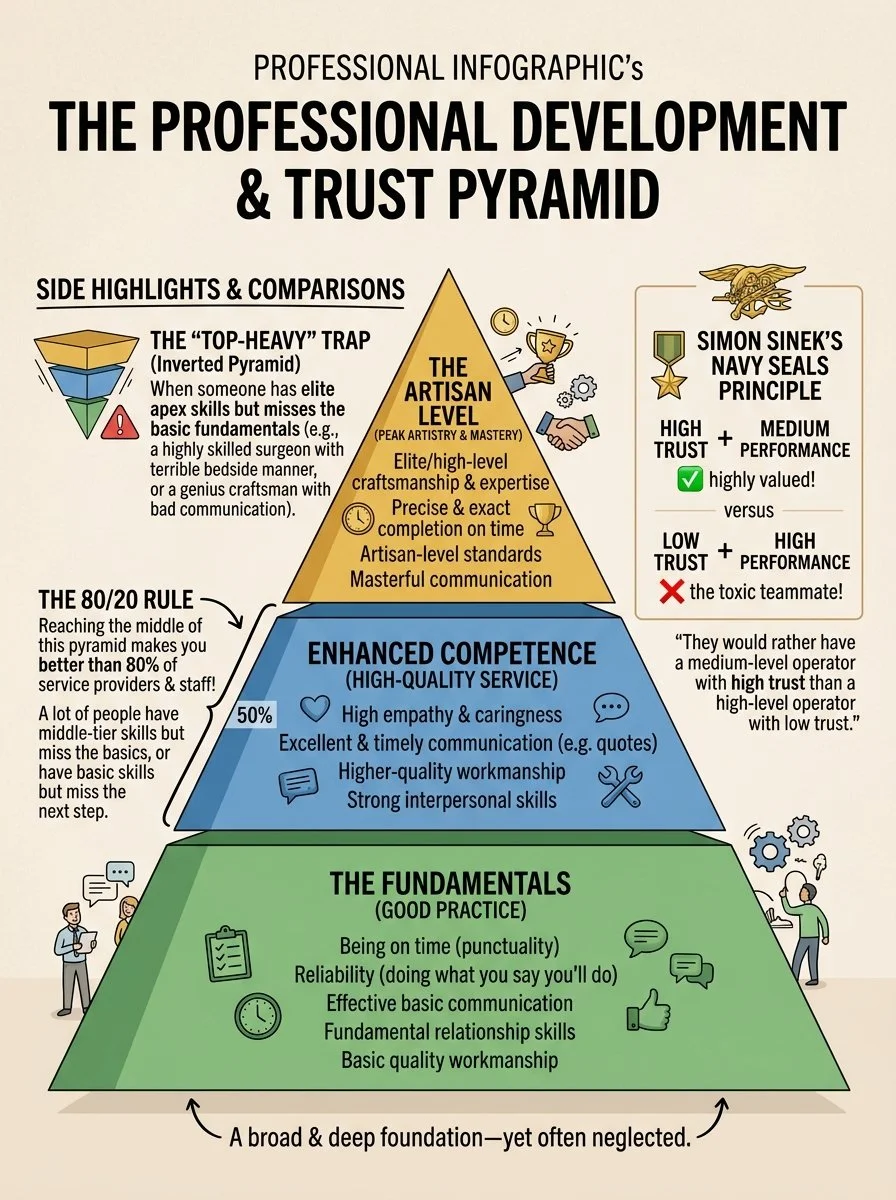
In any profession, whether we are talking about employees, service providers, or just being a decent human being, there is a sliding scale of capability and character. To make sense of what truly makes a "good" member of staff or service provider, we can look at it as a pyramid: The Professional Development Pyramid (see below).
While many focus entirely on reaching the "artisan" peak, the reality is that the true differentiator in the modern world isn't always elite craftsmanship. It’s also the fundamentals at the bottom, and the trust that holds it all together.
The Three Tiers of the Professional Pyramid
The pyramid is divided into three distinct levels, each building on the last. To understand why some people thrive while others struggle, we can look at how these tiers interact:
1. The Base: The Fundamentals of Good Practice
At the very bottom of the pyramid lies the broadest, deepest, and most crucial section: the fundamentals. These are the non-negotiables of being a reliable human being and a functioning member of any team.
Punctuality: Being on time.
Reliability: Doing what you say you are going to do.
Effective Basic Communication: Answering the phone, replying to messages, and keeping people informed.
Basic Relationship Skills: Having fundamental empathy, understanding, trustworthiness, honesty, and caring for the person on the other end of your service.
Basic Quality Workmanship: Possessing the standard, foundational skills required to do the job (for example, a roofer knowing how to safely and correctly lay a basic tile).
Problem Solving: Being proactive and accountable.
This is the bedrock. Without it, the rest of the pyramid has nothing to stand on. Yet, surprisingly, this is the area most frequently neglected.
2. The Middle: Enhanced Competence & Quality Service
As we move up, the skillset and interpersonal qualities become more refined. This is where a good worker becomes a truly valuable one.
Higher Quality Workmanship: Going beyond "good enough" to deliver truly great, durable work.
High Empathy & Caringness: Genuinely caring about the client’s experience or your teammate’s workload.
Excellent, Timely Communication: Being proactive—sending quotes quickly, addressing issues before they become problems, and actively listening.
Strong Interpersonal Skills: The ability to navigate difficult conversations, collaborate, and build positive, lasting relationships.
3. The Apex: The Artisan Level (Peak Artistry & Mastery)
At the very top sits the apex—highly specialized, elite-level mastery.
Elite Craftsmanship & Expertise: Exceptional, artisan-level standards that only a tiny percentage of people can achieve.
Precise, Exact Completion: Flawless execution, perfectly on time, every time.
Masterful Communication: Advanced, seamless navigation of complex environments.
The 80/20 Rule: Halfway Up is Better Than Most
We often assume that to be successful, we must claw our way to the very top of the apex. But there is a liberating truth about the 80/20 rule of professional standards: reaching just the middle of this pyramid makes you better than 80% of the people out there.
A vast number of service providers and employees have decent middle-tier skills, but they constantly trip over the bottom. They might be great at their craft, but they don't show up on time, they don't return calls, or they don't do what they said they would do. Conversely, some have the best intentions but lack the competence to get halfway up the triangle.
If you can master the fundamentals—showing up, communicating, and caring—and pair that with good, reliable quality (the middle tier), you will already be vastly more successful, trusted, and sought-after than the vast majority of your competition.
Beware the "Top-Heavy" Trap: The Inverted Pyramid
What happens when we ignore the base? We get the "Top-Heavy" Trap. This is an inverted pyramid—highly unstable and toxic.
This happens when someone possesses elite, apex-level skills but lacks the basic fundamentals. The classic example is the world-class surgeon who performs flawless, life-saving surgeries but has such a terrible bedside manner that patients and staff dread interacting with them. Or the genius contractor who can build a masterpiece but refuses to return your calls, misses deadlines, and leaves you completely in the dark.
In these cases, high skill is ruined by terrible character and communication. Over time, the instability of lacking a foundation causes this top-heavy structure to topple, leaving behind broken trust and frustrated teams.
Simon Sinek’s Navy SEALs Principle: Trust > Performance
This brings us to a vital insight popularized by Simon Sinek, regarding how the US Navy SEALs select their most elite teams.
When the SEALs evaluate candidates, they look at two metrics: Performance (how good you are on the battlefield) and Trust (how good you are off the battlefield, as a person).
High Performance + Low Trust = A toxic leader/teammate.
Medium Performance + High Trust = A highly valued, natural leader.
Sinek’s takeaway from the SEALs is profound: "They would rather have a medium-level operator with high trust than a high-level operator with low trust."
In the corporate world, we often promote and tolerate the "high performer with low trust"—the toxic high-achiever who makes everyone else’s lives miserable. But just like the Navy SEALs, the best teams, the best businesses, and the most successful service relationships are built on trust.
Conclusion
You don't need to be an elite, apex "artisan" to be highly successful and respected. Focus first on building a broad, unshakable foundation of fundamentals: show up, do what you say you’ll do, and treat people with basic respect and empathy.
Once you have those basics locked down, strive for good quality and excellent communication. By doing so, you will climb halfway up the pyramid—and find yourself head and shoulders above the rest.